
Quitting
Why I left my PhD program

In August of 2022, I waltzed into the famed ‘math camp’ that precedes the first year of an economics PhD. The instructor kicked off the session by defining a measure space on the board. Within a few minutes, I was lost, having expected a more casual review of the syllabus for the first day. That gentle introduction was nowhere to be found. Over the following weeks, however, I found my footing, got to know my new classmates, and enjoyed the waning Chicago summer. By the time classes rolled around, I felt ready and excited for the challenge to come.
The first year was difficult but, in many ways, exhilarating. The material was challenging yet not impossible. I learned much more than I had thought was attainable from one year of schooling. I found myself in the company of some brilliant people, and I was able to at least hold my own. I was in the room! I survived the Chicago economics core exams!
The Vision of an Academic Life
I would not have considered academia were it not for a few professors in undergrad who encouraged me to do so.1 I did not know any professors growing up, and, even after being in college, it was not clear to me what they actually did. One professor described to me the joys of a life of the mind. I was intrigued. I was only just beginning to participate in the research process and certainly not leading any of my own work, but I began to see the enduring delight of asking how the world works and seeking answers. So, I wanted to be a professor with the freedom of tenure.
Vanity, too, explains some of this vision for my life. In college, some of my friends told me they could see me as a professor. I found these observations incredibly validating. The vision of being a figure of intellect, authority, and status was intoxicating. I craved that life.
Proximity is Revealing
With this vision in mind, I started my PhD in 2022 brimming with excitement and optimism. By mid-2024, my vision of an academic life had firmly collided with reality. I quit. Why?
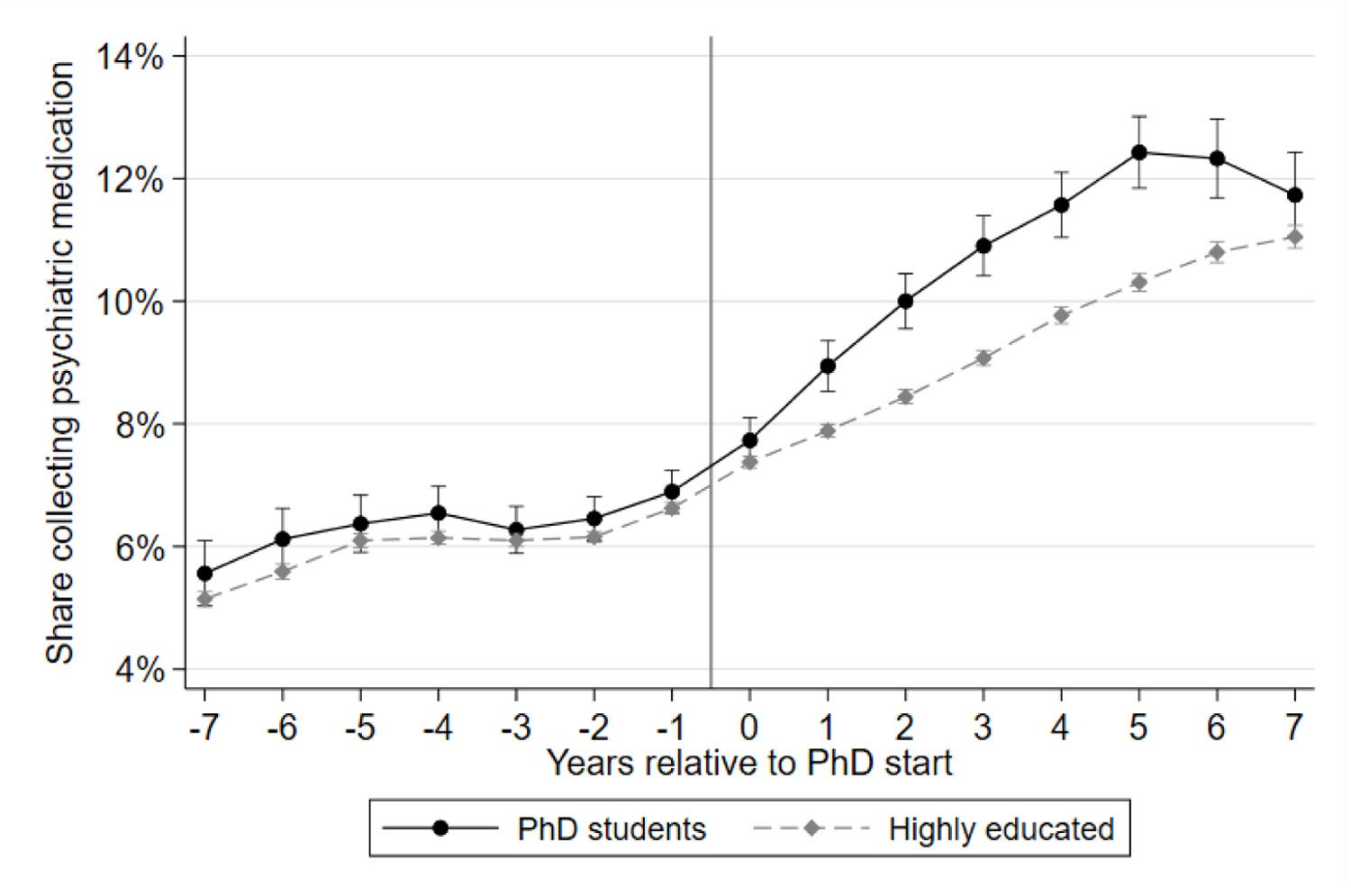
I was miserable. Despite having some wonderful friends in the program,2 I felt progressively more lonely and isolated in my second year. Accordingly, I didn't expect to be happy during my time as a PhD student. I figured I was just another data point in the famous graph from Bergvall et al. (2025):3
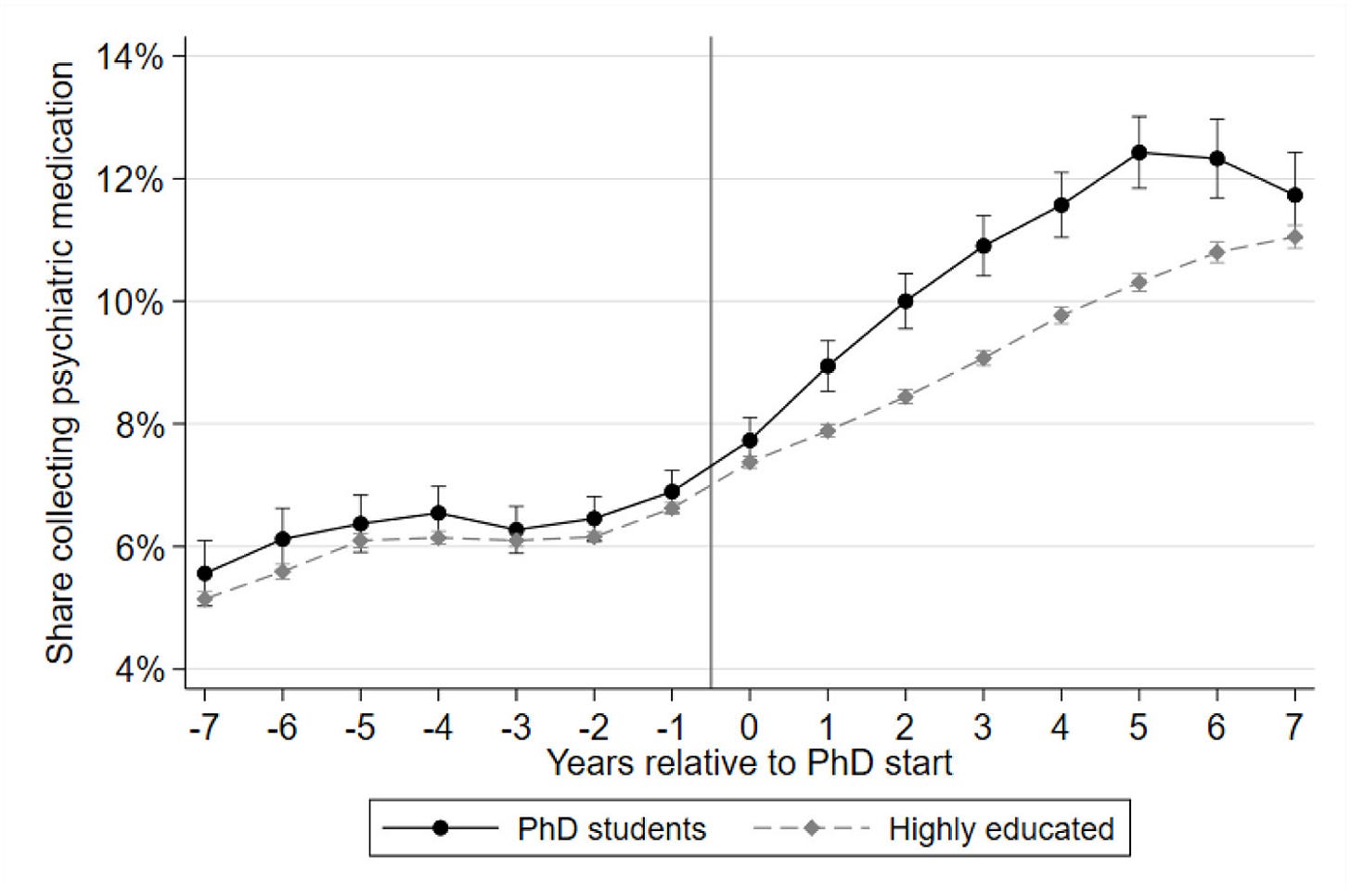
I was still willing to consider the case for delayed gratification, however. This consideration kept me going through much of the second year. Then, as the reasons I outline below piled up, the case for staying crumbled.
My vision of an academic life lost its appeal. I think starting a PhD is a great discernment tool,4 as it gives you unparalleled proximity to academic life. That proximity, and my reaction to it, were personally revealing. I met more professors and continued to admire their intellect and persistence. However, I realized I lacked the disposition to similarly thrive in academia.
First, I don’t have the patience to work on academic publication timelines. Throughout my two years in grad school, I tried and failed to publish a paper I worked on as a pre-doc. I grew frustrated with this process,5 and I felt rudderless with the extended feedback loops of academia.
Second, I much prefer working on teams. Some professors seem to do a great job of creating true teams for research, but this arrangement requires extensive funding and/or some serendipity in finding coauthors. I want to share in the highs and lows of my work with my colleagues.
Third, my criteria for work I found interesting diverged from the criteria on which my work would be judged. The projects I found most yielded feedback to the effect of, ‘how is this economics?’ I did not want to have to repeatedly justify my choices to work on problems I feel to be important, especially if my aesthetic sense of good work differed from the field’s own aesthetics.
Fourth, I don’t have the raw intellectual firepower to make academia work on my own terms. Some people can accomplish this, and those people are deeply exciting to meet. However, I doubted I would achieve what they did.
The alternative was readily attainable. If not academia, I still wanted to work in a field adjacent to academic research. I suspected a think tank would be the right fit. I started part-time work at FRI to test out this thesis. After a couple of months, I was quite excited at the prospect of joining a think tank after graduation, and I was especially interested in joining FRI. I received a full-time offer, which helped me to realize that a PhD likely wouldn't alter my career trajectory at the organization. With that realization, the delayed gratification argument in (1) fell apart. Why postpone the end goal?
The types of skills you acquire in a PhD vary by your seniority. I learned a great deal in my first 2 years of the PhD, especially in statistics, model-based thinking, and evaluating research. I might have delayed the jump out of academia because of the continued upskilling in years 3-6 of the PhD. As I alluded to above, I felt that I was learning how to do research that was both rigorous in the eyes of and aesthetically pleasing to the economics profession, rather than do work I personally found important and compelling. I also wanted to learn how to collaborate with and manage teams. While I was still learning a great deal, I wasn’t necessarily learning the skills I wanted to. At FRI, I knew I could take on both research and people management. The transition to management has been challenging but also gratifying.
I did not have the social life I wanted. I now live in the same city as many of my closest friends, am able to travel to see other friends more, and generally have more free time. I like these developments, and I wanted these things when I was in grad school.
I became more confident in self-study. The first 2 years of the program were challenging, and I ended up (in collaboration with my peers) doing plenty of self-study. I, for example, learned the basics of Python and how to train a DNN. I have since been able to continue this self-study in a number of domains, e.g., tinkering with LLMs to get them to play a Survivor-like game against each other (among some more serious endeavors).
Some Things I Will Miss
I would hate to give the impression that this decision was a Pareto improvement, because I think that would be misleading. Given my preferences, I was happy to make these tradeoffs, but many people I know, like, and respect should (and have) decided differently.
First, in years 2-6 of the PhD, the combination of near-complete freedom to explore questions you think are interesting with job security is special. I have questions that I am super excited about but cannot explore because I don’t get an ultimate say over what I work on. I still like the questions we study at FRI, and I suspect I’m quite lucky in the degree of overlap in what I think is interesting and what I get to work on. Nevertheless, I have less freedom than I did before. And, it’s quite possible I could have ended up in a situation where there was substantially less overlap. I think anyone contemplating leaving their PhD should take these restrictions seriously.
Second, the standards of rigor are different. You should consider where you want to be in the space of rigor, relevance, and translatability to real-world decisions.
Third, it is satisfying to finish things and dissatisfying to give them up. I will be quite proud of my friends who finish the program, and I suspect I will feel some pangs of regret, maybe even jealousy, when they do. After all, it’s a path not taken.
I remain profoundly grateful for the vote of confidence in my potential.
Many people deserve appreciation here, but I especially want mention Aaron, Drew, and Matt. I miss seeing them and many other people multiple times a week.
In the interest of transparency, I started an antidepressant after my first year. I am still on that antidepressant, although at half the dose I was on during grad school.
I’ve settled on some pithy advice here: more people should start PhDs, and less people should finish them.
The frustration has more to do with timing rather than the ultimate assessment of the work.
Your description of the way that academic life lost its appeal makes me glad I did not pursue a PhD (something I at one time considered). I think I would have had much the same findings as you
Very enjoyable reflective piece, and I think will be helpful to many future students.
I want to push back on "more people should start PhDs, fewer should finish them." The implicit claim is that starting a PhD is the best way to learn whether academic life suits you. But is it? The information you gained might have been discoverable through a predoc or conversations with academics. Those paths cost less in time, money, and opportunity (especially given the costs of applying: writing statements, getting letters, sitting the GRE etc).